In June 2018, I received my PhD in Aeronautics and Astronautics from Stanford University and accepted a job offer at a tech startup, where I will no longer be focusing on academic research. Henceforth, this particular page will fall out of date on my current activities, but will continue to serve as a recap of the work performed in the process of earning my PhD.
Aerospace Computing Lab, Stanford University
Our lab website:
http://aero-comlab.stanford.edu
Side note: see this page for a collection of useful odds & ends I've picked up in the process of working on my research.
My current research is on creating better methods for applying overset grids to high-order CFD (high-order discontinuous finite-element type methods), which improves the interpolation accuracy between overset grids. In particular, my current work is focused on applying modern hardware to these problem in order to create a robust, accurate simulation method capable of solving problems of industrial interest. This includes developing novel connectivity algorithms for overset grids on GPUs.
http://aero-comlab.stanford.edu
Side note: see this page for a collection of useful odds & ends I've picked up in the process of working on my research.
My current research is on creating better methods for applying overset grids to high-order CFD (high-order discontinuous finite-element type methods), which improves the interpolation accuracy between overset grids. In particular, my current work is focused on applying modern hardware to these problem in order to create a robust, accurate simulation method capable of solving problems of industrial interest. This includes developing novel connectivity algorithms for overset grids on GPUs.
ZEFR
The current GPU-based Flux Reconstruction code under active development in the lab - another descendant of HiFiLES - is ZEFR. Like Flurry, it is capable of solving the full Navier-Stokes equations on moving overset grids in 3D, by linking to (my modified version of) the open-source domain-connectivity library Tioga (https://github.com/JacobCrabill/tioga/). A current application being explored with these two codes is that of a golf ball, with the end goal being to accurately simulate its full trajectory including all effects from spinning, transition, separation, etc. Computation has been performed on the XStream cluster at Stanford (based on the NVIDIA Kepler K80 architecture).
ZEFR currently exists in a private Git repository, but is planned to be released open-source in the near future alongside of a journal publication on its capabilities and implementation details.
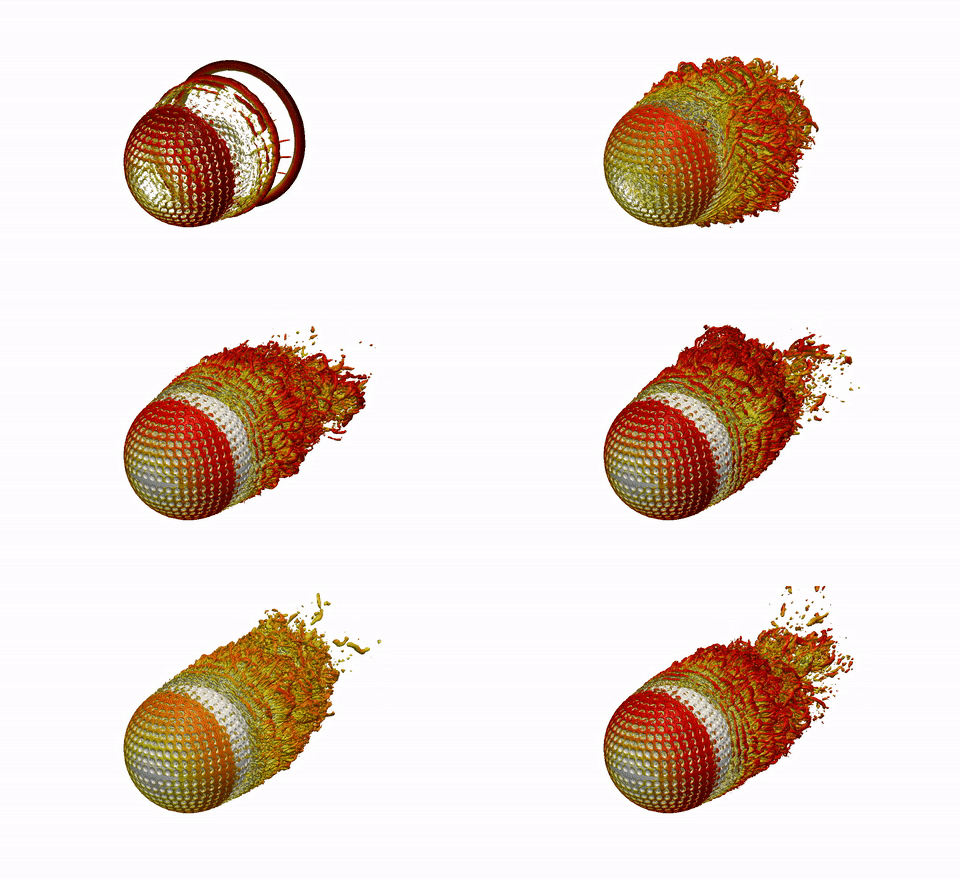
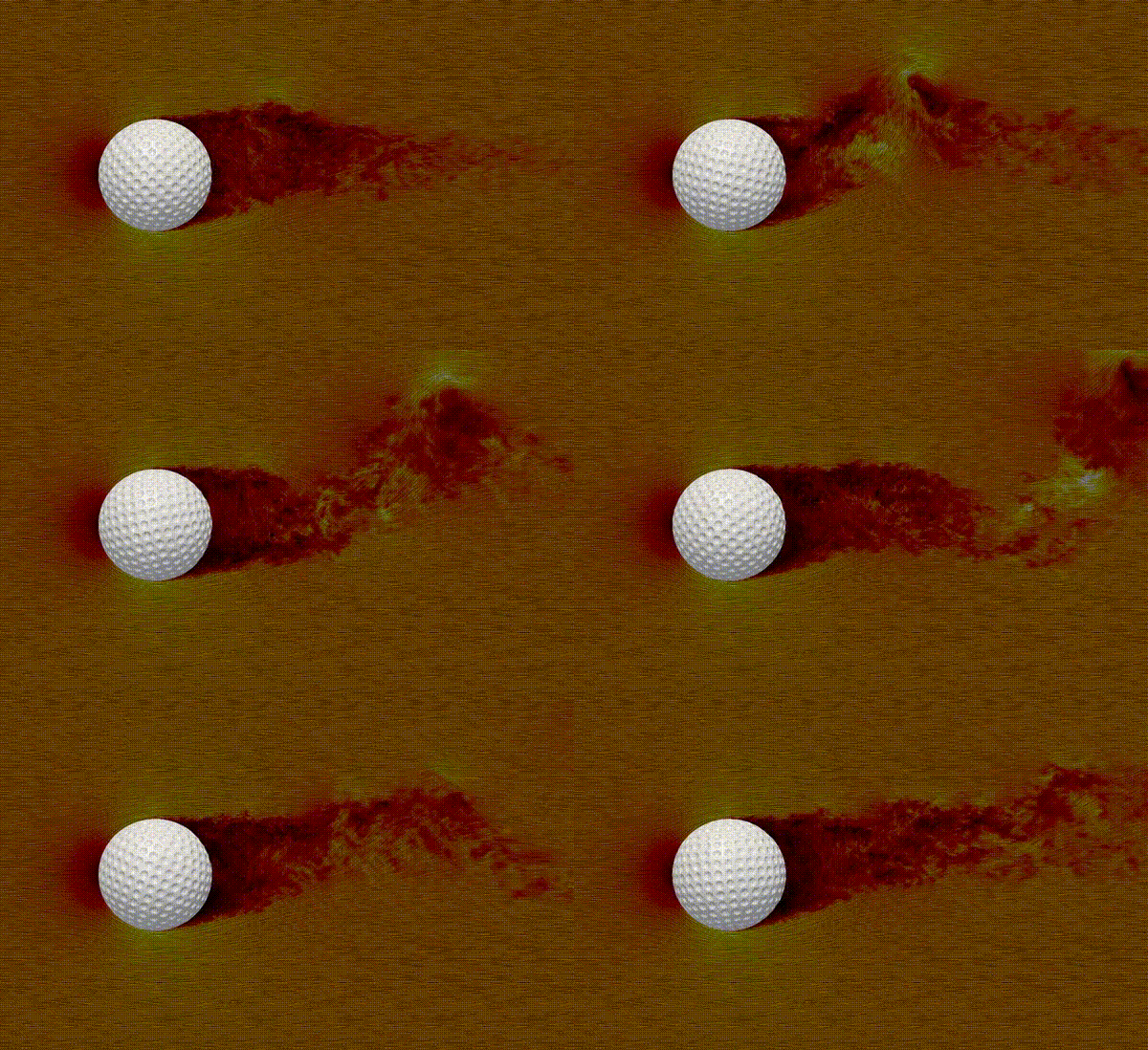
Below are snippets from my current showcase simulation: that of a golf ball at a realistic Reynolds number. The stretch goal is to simulate the entire trajectory of a golf ball, but for now the overset capabilities of ZEFR and Tioga are simply being verified on static and prescribed-spin cases.
ZEFR currently exists in a private Git repository, but is planned to be released open-source in the near future alongside of a journal publication on its capabilities and implementation details.
Below are snippets from my current showcase simulation: that of a golf ball at a realistic Reynolds number. The stretch goal is to simulate the entire trajectory of a golf ball, but for now the overset capabilities of ZEFR and Tioga are simply being verified on static and prescribed-spin cases.
|
|
Publications
High-Order Computational Fluid Dynamics Simulations of a Spinning Golf Ball
Sports Engineering, May 2018
arXiv: https://arxiv.org/abs/1806.00378
A Parallel Direct Cut Algorithm for High-Order Overset Methods with Application to a Spinning Golf Ball
Journal of Computational Physics, Volume 374 (December 2018), pp. 692-723
Science Direct: www.sciencedirect.com/science/article/pii/S0021999118303450?via%3Dihub
arXiv: https://arxiv.org/abs/1711.07663
A High-Order Overset Method on Moving and Deforming Grids
AIAA Modeling and Simulation Technologies Conference, Jun 2016
AIAA Library: https://arc.aiaa.org/doi/pdf/10.2514/6.2016-3225
Sports Engineering, May 2018
arXiv: https://arxiv.org/abs/1806.00378
A Parallel Direct Cut Algorithm for High-Order Overset Methods with Application to a Spinning Golf Ball
Journal of Computational Physics, Volume 374 (December 2018), pp. 692-723
Science Direct: www.sciencedirect.com/science/article/pii/S0021999118303450?via%3Dihub
arXiv: https://arxiv.org/abs/1711.07663
A High-Order Overset Method on Moving and Deforming Grids
AIAA Modeling and Simulation Technologies Conference, Jun 2016
AIAA Library: https://arc.aiaa.org/doi/pdf/10.2514/6.2016-3225
Dissertation
Towards Industry-Ready High-Order Overset Methods On Modern Hardware
Completed June 2018
PDF: https://searchworks.stanford.edu/view/12649134
Completed June 2018
PDF: https://searchworks.stanford.edu/view/12649134
Presentations
PhD Dissertation Defense - Friday, April 27, 2018
USNCCM14 - Montreal, July 2017
Flurry++
I previously developed my own "sandbox" code based on HiFiLES, but with an emphasis on simplicity and ease of modification rather than performance. The code is hosted on my GitHub account here:
http://jacobcrabill.github.io/FlurryPP/
The code's capabilities were constantly evolving, with my final emphasis being on implementing and improving overset-grid methods for 2D and 3D problems with moving grids. For more details on the code and my current research activities related to it, check out my Github site linked above.
http://jacobcrabill.github.io/FlurryPP/
The code's capabilities were constantly evolving, with my final emphasis being on implementing and improving overset-grid methods for 2D and 3D problems with moving grids. For more details on the code and my current research activities related to it, check out my Github site linked above.
HiFiLES
Previously, the lab developed an open-source high-order Flux Reconstruction CFD code:
https://hifiles.stanford.edu/
https://github.com/HiFiLES
My previous research activities included applying mesh deformation/adaption techniques to high-order CFD within the lab's open-source Flux Reconstruction code, HiFiLES.
https://hifiles.stanford.edu/
https://github.com/HiFiLES
My previous research activities included applying mesh deformation/adaption techniques to high-order CFD within the lab's open-source Flux Reconstruction code, HiFiLES.
